
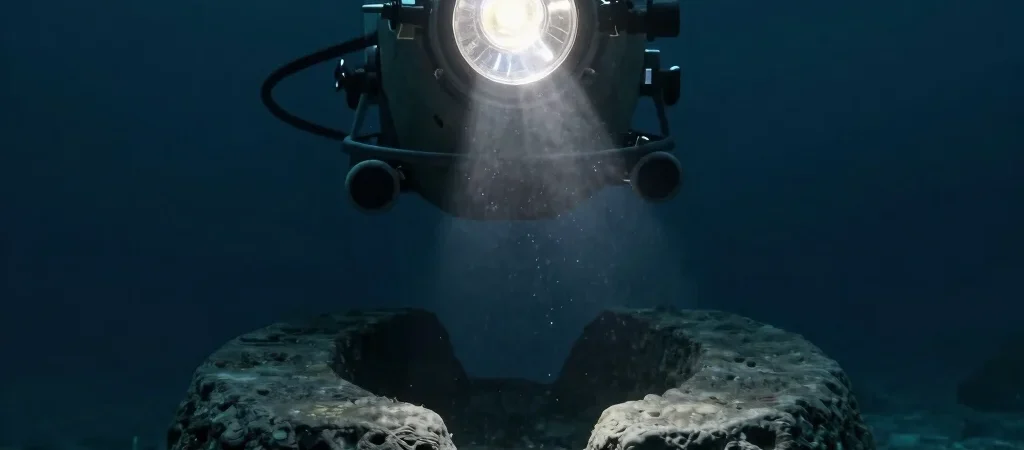
During late-autumn bathymetric mapping off the coast of Scandinavia, marine research vessels recorded a series of high-density acoustic reflections that defied standard seabed topographies. Rather than the expected rolling silt or fractured granite, the equipment rendered a symmetrical structure featuring right-angled depressions and uniform elevation shifts. While sensationalist reports immediately claimed the discovery of non-human craft, field notes from the hydrographic crew suggest a far more complex investigative process.
A Signal Beyond Instrument Noise
Initial hypotheses focused on calibration drift or sub-surface gas plumes capable of distorting sonar telemetry. Subsequent passes using side-scan sonar arrays, however, confirmed that the anomaly reflected acoustic pulses with the uniform density typical of compressed basalt or processed alloy. The geometry remains distinct from known glacial dropstones, raising legitimate questions among geological survey teams.
Separating Acoustic Reflection from Solid Mass
Investigating such depths requires strictly isolating hard measurement from observational bias. Physical core samples retrieved near the perimeter revealed mineral compositions standard to the regional shelf, yet multi-beam bathymetry continues to output structural lines that appear engineered. Independent oceanographers stress that marine erosion can occasionally mimic artificial angles under specific current conditions.
What the Current Archive Proves
Until autonomous underwater vehicles collect high-resolution optical footage and direct physical scrapings from the central mound, the Baltic trench site sits firmly in the unresolved column. The documented evidence confirms an anomalous seabed contour, but science demands corroborating physical samples before reclassifying the site as anything beyond a geological irregularity.